• Home
  • About
    • Press
    • Press Kit
  • Singer
    • Listen and Watch
    • Repertoire
  • Composer
    • Sheet Music Store >
      • Shop All
      • Chamber Music
      • Choir
      • Coaching
      • Educational
      • Guitar
      • Harp
      • Large Ensemble
      • Opera
      • Percussion
      • Piano
      • Solo Voice(s) >
        • Art Song
        • Opera Arias
        • Unaccompanied Vocal
        • Chamber Vocal
        • Young Singers
        • Spoken Word/Narrator
      • Strings
      • Woodwinds >
        • Oboe
        • Saxophone
        • Flute
        • Clarinet
        • Bassoon
      • Brass
    • Catalog
    • Discography
    • Report a Performance
  • Events
  • More
    • Actor
    • Voice & Composition Lessons
    • Contact
LISA NEHER
  • Home
  • About
    • Press
    • Press Kit
  • Singer
    • Listen and Watch
    • Repertoire
  • Composer
    • Sheet Music Store >
      • Shop All
      • Chamber Music
      • Choir
      • Coaching
      • Educational
      • Guitar
      • Harp
      • Large Ensemble
      • Opera
      • Percussion
      • Piano
      • Solo Voice(s) >
        • Art Song
        • Opera Arias
        • Unaccompanied Vocal
        • Chamber Vocal
        • Young Singers
        • Spoken Word/Narrator
      • Strings
      • Woodwinds >
        • Oboe
        • Saxophone
        • Flute
        • Clarinet
        • Bassoon
      • Brass
    • Catalog
    • Discography
    • Report a Performance
  • Events
  • More
    • Actor
    • Voice & Composition Lessons
    • Contact

Dr. Lisa Neher Named "Composer of the Year" by oregon Music Teachers Association (OMTA) and Iowa Music TEachers Association (IMTA)

5/8/2025

 
Picture
May 5, 2025 – PORTLAND, OR – Portland-based new music powerhouse Dr. Lisa Neher has been named as the 2025 Composer of the Year by the Oregon Music Teachers Association (OMTA) and the 2025 Commissioned Composer by the Iowa Music Teachers Association (IMTA).

Each year, Music Teachers Association chapters from around the country recognize outstanding talent in their state with the Composer of the Year Award. As an honoree, Neher receives not only a commission from OMTA and IMTA, but will represent each state in the competition for the national Distinguished Composer of the Year Award, hosted by the Music Teachers National Association.

“Lisa’s solid, heartfelt, and timely writing put her on the top of our lists,” shared OMTA Composer-of-the-Year committee members, Paul Safar and Amy Fairchild. “We are proud to have Lisa represent Oregon at the MTNA competition this year.”

The commission, Love in a Time of Climate Change, features text by poet Craig Santo Perez, and will be premiered by soprano Lindsey Rae Johnson and pianist Dianne Davies at the OMTA State Conference in the Florence Event Center on Saturday, June 28th. This work marks the third collaboration between Neher and Perez—their last major song cycle (which also included text by Felicia Zamora), No One Saves the Earth from Us But Us, was funded in part by the University of Oklahoma Faculty Senate and the University of Cincinnati Office of the Vice President for Research, to be premiered at a Cincinnati Song Initiative concert this May.

In Iowa, pianist and MTNA West Central Division Director-Elect Jason Sifford will present the world premiere of Lisa’s instrumental work, Nautilus, at St. Ambrose University in Davenport, Iowa as part of the 2025 IMTA conference on June 8, 2025. A 7-minute piano solo, the work explores the nautilus’s biology, behavior, and ecosystem.

“Working with Lisa was a natural choice for our organization,” reflects Sifford. “She has maintained close ties with our community and her work has a strong, unique voice. We are looking forward to the premiere of Nautilus and are proud to have found a place in her growing catalogue.”

Described by Willammette Week as “not only as a supremely talented artist, but an unfailingly compassionate creator whose passion for animals and the natural world propels her work,” these commissions are the latest in a long-standing career of award-winning, socially-conscious music.

“A friend told me, ‘facts speak to our minds, but art speaks to our hearts,’” shares Neher. “It’s easy to get overwhelmed by the facts of climate change–to dissociate and to freeze. When we feel something, it can propel action.”

NOTE TO JOURNALISTS: Lisa Neher and Craig Santos Perez are available for print, online, and broadcast interviews. If you would like more information on the work, the premiere, or would like to schedule an interview, please contact Lisa directly at lisanehermusic (at ) gmail (dot) com.
Picture
Dr. Lisa Neher, Composer
Picture
Craig Santos Perez, Poet
ABOUT DR. LISA NEHER (Composer)
​Dr. Lisa Neher (b. 1985, she/her, “NEER”) is an award-winning composer and new music mezzo on a mission to transform audiences through sound, story, and vulnerability. With a voice praised as “full and rich” and “especially alive” (Oregon ArtsWatch), Neher’s performance credits include Portland Opera, Third Angle New Music, Really Spicy Opera, Portland Columbia Symphony Orchestra, Opera Theatre Oregon, New Music Gathering, Resonance Ensemble, Experiments in Opera, Renegade Opera, and Big Mouth Society.

Described as a “supremely talented,” “visionary composer” (Willamette Week), “maestro of beautifully wacky noises” (Oregon ArtsWatch) and author of “liquid, impressionist piano writing and fluent melding” of voices (New York Classical Review), Neher’s compositions are inspired by the climate crisis, the tender love of family and friends, and the eerie mystery of deep ocean life. She is Composer in Residence for the Beaverton Community Band. She has been commissioned and performed by the National Association of Teachers of Singing, Cincinnati Song Initiative, Third Angle New Music, FearNoMusic, Dinosaur Annex, New Opera West, Mirror Visions Ensemble, Alma Ensemble, Opera Elect, and Opera Santa Barbara, among others.

Her awards include OMTA Composer of the Year, IMTA Composer of the Year, Flute New Music Consortium Competition, ICDA/ICF Choral Competition, Mirror Visions Ensemble Young Composer Competition and the Celebris Ensemble Choral Competition.

As the founder and Executive & Artistic Director of New Wave Opera, she has fostered the successful performances of musical works by over fifty living composers and writers, including eight complete opera productions featuring over three dozen Oregon-based vocalists, instrumentalists, and theatre professionals.

Neher holds a Doctor of Musical Arts in Voice Performance & Pedagogy from the University of Iowa, a Masters of Music in Composition from the University of Kansas, and undergraduate degrees in Music and Theatre from Lewis & Clark. She is an alumna of the Gabriela Lena Frank Creative Academy of Music and the Cortona Sessions for New Music.
www.lisanehermusic.com

ABOUT CRAIG SANTOS PEREZ (Poet)
Craig Santos Perez is a native Chamoru from the Pacific Island of Guåhan/Guam. He is the co-founder of Ala Press, co-star of the poetry album Undercurrent (Hawai’i Dub Machine, 2011), and author of two collections of poetry: from unincorporated territory [hacha] (Tinfish Press, 2008) and from unincorporated territory [saina](Omnidawn Publishing, 2010), a finalist for the LA Times 2010 Book Prize for Poetry and the winner of the 2011 PEN Center USA Literary Award for Poetry. He is an Assistant Professor in the English Department at the University of Hawai’i, Manoa, where he teaches Pacific literature and creative writing.                                     
https://craigsantosperez.wordpress.com/
Soprano Lindsey Rae Johnson
Pianist Dianne Davies
ABOUT LINDSEY RAE JOHNSON (Soprano)
Lindsey Rae Johnson (she/her) is a versatile vocalist and performer originally from Minneapolis, now based in Portland, Oregon. She has graced local stages with Portland Opera, New Wave Opera, Renegade Opera, OperaBend, Ping & Woof Opera, Lark Opera, Queer Opera, Opera on Tap, Opera in the Park, Light Opera of Portland, Mocks Crest Productions, Classical Revolution PDX, and the Dickens Carolers. Recent roles include Camila (Pepito), Asha (Meow and Forever), Jane (Serial Killers and the City), Narrator (Thump), Maya (Sense of Self), Victoria Booth/Vitellia (La clemenza di Tito), Freia and Wellgunde (Das Rheingold), Foreign Princess (Rusalka), and Gertrud (Hänsel und Gretel). 

Beyond Oregon, Lindsey has performed with esteemed organizations such as Fort Worth Opera, the San Francisco Symphony Chorus, Lamplighters Music Theatre, Cedar Rapids Opera Theatre, Bay Area Summer Opera Theater Institute, Waffle Opera, Oberlin in Italy, the Frost School of Music in Salzburg, and Sieur Du Luth Summer Arts Festival. 

A passionate advocate for innovation in opera, Lindsey is Co-Founder and Resident Soprano of New Wave Opera and serves on the AGMA Board of Governors and NW Area Committee. She holds music degrees from Luther College and the University of North Texas.   www.lindseyraejohnson.com

“Lisa is unafraid to make bold and daring choices—and it makes her extremely fulfilling to work with as a vocalist. Her expertise shines through in every project, from her prowess in text setting and musical storytelling to her deep sensitivity in crafting interesting lines that fit naturally in the voice. Her latest work may challenge the audience, but her wit, creativity, and sincerity will spark both laughter and deep feeling from listeners.”
Lindsey Rae Johnson


ABOUT DIANNE DAVIES (Piano)
Dianne Davies has been a collaborative pianist since she was in the fifth grade, playing for congregational singing at church, accompanying her classmates in competitions to playing for the fifth grade choir and school musical at Hartley Elementary in the Reynolds District. Ever since, collaborating has been top on her priority list for performance. Beyond her Bachelor of Arts degree in Piano Performance and completing the Oregon music education certification for K-12 instruction at Lewis & Clark College, Dianne has been provided a plethora of performance opportunities.

Dianne is also a composer and since 2017 her compositions for students have been performed in the Cascadia Composer’s sponsored concert In Good Hands, a concert that links music students with local living composers. Many OMTA teachers have worked with her as a composer for their students.

In addition to her passion for performing, she operates a full piano studio spanning ages K-12 to recreational adults. Dianne is Nationally Certified through MTNA and is starting her journey as a Syllabus adjudicator. At the state level of OMTA Dianne chairs the State Composition Festival and at the National level she chairs the State Composition Competition. Dianne is committed to bringing up the next generation of composers.                                          www.musiqPOWER.com

“Lisa’s music engages audiences in creative and meaningful ways. She is world class—definitely a force to be reckoned with.”
–Dianne Davies

The Overlooked Opera Performer

6/15/2022

 
I’m all about helping composers "up" their composing for singers game—everything from text setting to poetry permissions to range, tessitura, and voice types & more!

It’s a particularly important subject during this current renaissance of new opera. So many composers are developing new operatic works.

But there’s someone else to keep in mind as you write your vocal works. Someone who often gets overlooked, ESPECIALLY in opera writing.

Your pianist.

If you’re writing an opera, you’ve probably heard about taking your orchestral or chamber score and creating a piano reduction—a rehearsal score that singers will use in lessons, coachings, musical, and staging rehearsals. These rehearsals are ALL done with only a rehearsal pianist—not the full ensemble—for budget reasons. The instrumental ensemble only joins for the very last few rehearsals.

My #1 tip for you:
Make sure that piano part is beautiful, idiomatic, and artistic.
Make sure that it stands ON ITS OWN.

Why?
  • Just look at HOW MUCH TIME your singers, director, designer, and more will be spending with the piano vocal score! It’s most of that rehearsal process.
  • Smaller companies, colleges, scene programs & festivals typically only have the budget to do your opera in the piano version. That means most people will experience your opera in the piano vocal version.
  • The strength of the piano vocal version will be what convinces a group to take the plunge and invest in performing the full version of your opera.
  • Not to mention: your pianist is a highly skilled performer who deserves gorgeous, playable music! And many pianists who work in opera are opera coaches or directors as well, who have the opportunity to recommend your piece to others if they like it.
 
The sad fact is that many of the piano reductions I see are simply NOT playable. They suspiciously like what notation software spits out when you use their automatic “arrange” functions. This forces your pianist to rework your reduction in real time during practice and rehearsal, crossing out notes that don’t fit in their hands, leaps that are impractical, and sometimes even cutting out that chord or motive that is supposed to be an important cue for the singers—YIKES!

Don’t let that be you. Take that extra time (and negotiate for extra money in your commissioning fee!) to make sure that the piano reduction isn’t just an automated “arrangement” of what the ensemble plays, but a thoughtfully composed piano version. A version that provides all the necessary elements for the director, designer, and singers to rehearse and stage your show AND that makes expressive, beautiful, crafted music on its own. It’s more work. But it’s worth it.

5 Resources for setting your commissioning rates

11/11/2021

 
How much do you charge for your music?

That question can make composers sweat bullets!

Maybe this is you...
  • You dream of having a calendar full of commissions
  • You long for performers and ensembles to take the initiative to contact you and ask you to write for them
  • You want to be seen as a professional, for your music to be respected, programmed, sought-after, and paid for

When that moment happens, you need to be ready.

Because pretty soon, the conversation is going to move from what kind of piece they want and what they love about your music to the scariest of questions: "How much do you charge?"

The most important step you need to take? Figure out your rates now.

Here are a few resources you can consult:

New Music Box Commissioning Fees Calculator
Canadian League of Composers Commissioning Rates
New Music USA's Commissioning Music: A Basic Guide
Meet the Composer's Guide to Commissioning Music
Dominick DiOrio's Guide to Commissioning Music (especially helpful for choral works)
American Composers Forum Commissioning By Individuals Guide

Have a look through these tools and documents. As you read, notice: how do these rates make you feel? Excited? Nervous? Affirmed? Terrified? Do you feel ready to ask a commissioner to pay you these rates? Why nor why not? 

Drop me a line and let me know.

The secret to writing great high notes for singers

10/29/2021

 
Listen to any art song, opera aria, choral work, or your favorite pop song, and you'll find something in common: dramatic high notes.

Those awesome moments in a piece of music that create drama and intensity by singing in the upper register. 
The trouble is, sometimes, they're written in a way that causes this effort to create a real MOMENT fall FLAT.

Let me explain.⁣
⁣
To sing a high note, a singer's mouth needs to be open tall in order to get the best sound and have the best chance of singing it with ease. And because singers perform text, it makes a HUGE difference what word you've chosen to set for that dramatic moment. That's because words are combinations of vowels and consonants, and because singers sustain vowels for most of the length of any given pitch.⁣ 𝘈𝘯𝘥 𝘯𝘰𝘵 𝘢𝘭𝘭 𝘷𝘰𝘸𝘦𝘭𝘴 𝘢𝘳𝘦 𝘦𝘲𝘶𝘢𝘭𝘭𝘺 𝘴𝘶𝘪𝘵𝘦𝘥 𝘵𝘰 𝘩𝘪𝘨𝘩 𝘱𝘪𝘵𝘤𝘩𝘦𝘴. ⁣
⁣
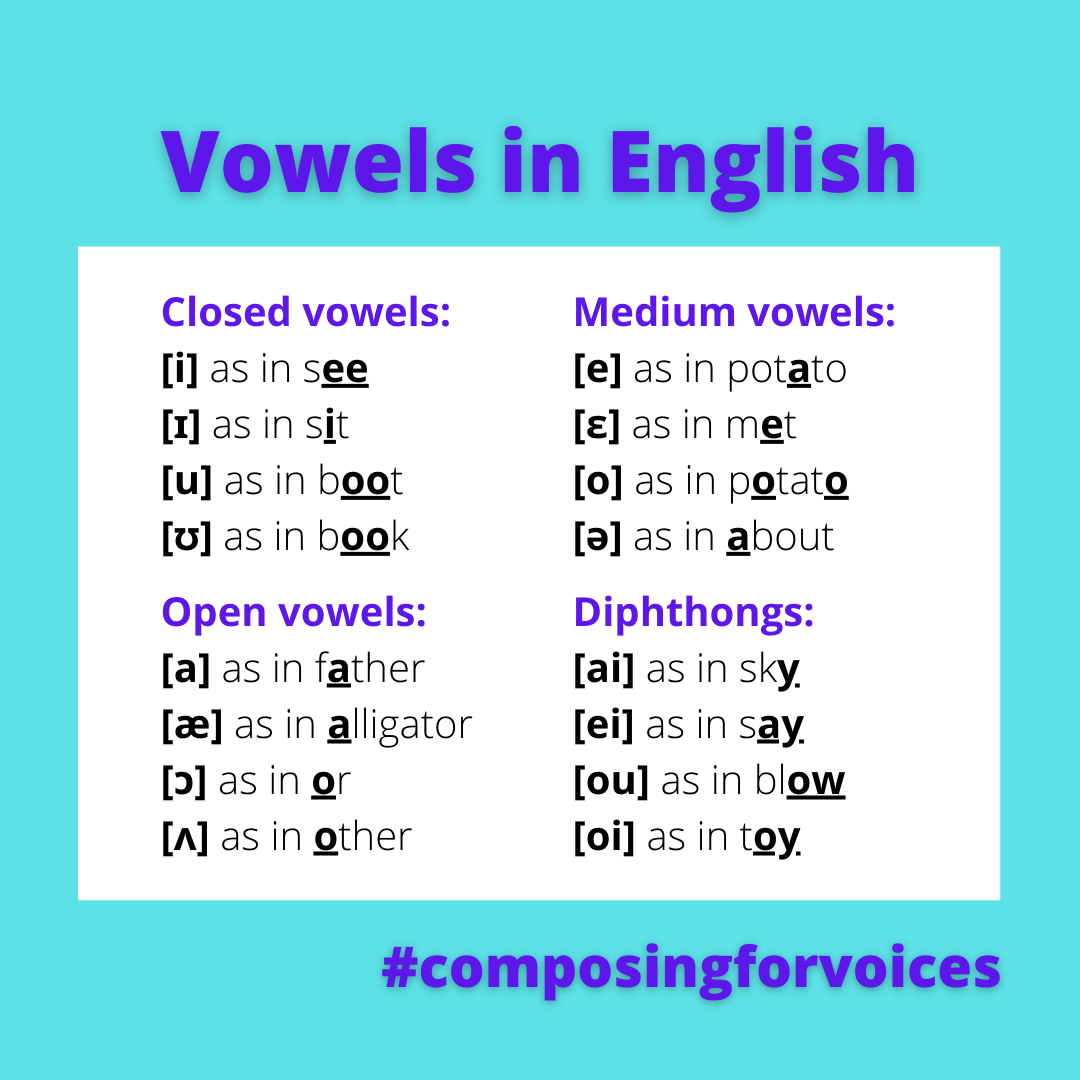
Here's why:⁣ vowels can be open, medium, or closed. ⁣
​
Try this: ⁣
Speak the words on the vowel chart slowly while watching your mouth in a mirror. Pay attention to what you see and feel⁣.
Picture

Notice that closed vowels involve closure of the mouth space either through lip rounding (boot, book) or through activation of the tongue into a little arch (see, sit).⁣⁣
⁣⁣
For the medium vowels, the lips are a little less rounded (potato) and the tongue is less arched (potato, met) or fairly neutral (about).⁣⁣
⁣⁣
And for the open vowels, lip rounding is even less (or), and the tongue is pretty much at rest in the bottom of the jaw (alligator, father, other).⁣⁣
⁣
See why they’re called open vowels? There’s literally less going on in the mouth and around the lips!⁣⁣
⁣⁣
Now that you’ve tried this out, let me give you a handy principle to keep in mind: ⁣⁣
⁣⁣
A property of singing is that high notes require a taller mouth than low ones. As singers ascend in range, we drop our jaws and lift the yawn space (soft palate) behind our upper molars to create more vertical space.⁣⁣
⁣⁣
And that’s why the open vowels can be sung on high notes more easily & beautifully while also being better understood by the audience!⁣⁣
⁣
⁣Let's take this a littler further. 
Diphthongs are single syllables that combine two vowel sounds (di = two, phthong = sound). ⁣⁣⁣They are super common in English. 
⁣⁣
Try this: ⁣⁣Slowly speak the diphthongs and identify which components are open, medium, and closed.⁣⁣
Which diphthongs will be more successful on a high note? Let me know in the comments! ⁣

21 Ways to support Living composers

10/25/2021

 
My friend Danielle Kuntz, harpist asked a great question on Twitter today: 

How do we support and encourage living composers?

I love this question, and it's one I get a lot. Performers, ensemble directors, music teachers, and music fans know that the odds have been stacked against living composers for a while. They want to take meaningful action, and they also know they can't do it all at once or all on their own. Many performers I talk to get stuck because they want to offer composers big commissions but don't have a dedicated funding source for that. 

It doesn't have to be hard to support living composers. You can get started right now. It doesn't have to cost a thing. 

Here's a list of 21 ways you can support living composers:
  1. Regularly seek out composers & works that are new to you. 
  2. Introduce a fellow performer, teacher, or ensemble director to one of your favorite composers.
  3. Share a recording by a composer you appreciate with a friend. Invite a friend to accompany you to a concert or to tune into a livestream with you that features music by composers you like. 
  4. Stream and purchase our albums. Like and review them on streaming platforms. Share on social media with a comment about why you like our music. 
  5. Purchase & perform our existing music. 
  6. If you teach, seek out & include music by living composers to use in your studio/class. 
  7. Don't make illegal copies of our music. If your budget is too tight, reach out to us and ask for an accommodation. Most composers I know will be happy to work with you. 
  8. Performers are often quite skilled at communicating with audiences about the pieces they perform. Your program note or verbal introduction to our music makes a big difference! Share what you say about our music and how you introduced our music to audiences with us. 
  9. Record your performances (even just on your phone) and share with composers so we can use recordings on our websites & social media.
  10. Perform new works multiple times, take them to festivals & conferences, take our works on tour with you to share them with wider audiences of music fans and fellow performers & ensembles.
  11. Let us know about performances of our pieces in advance so we can promote them on our websites & social media channels, share them with our email lists, and add them to our CVs. (Composers are regularly asked to submit CVs listing our works & performances when applying for calls for scores, festivals, grants, etc.).
  12. Send us programs from each performance as PDFs or JPGs so we can submit performances for royalties from our Performing Rights Organizations (ASCAP, BMI, etc.).
  13. Tell us the things you appreciate in our work. Be specific. Most of the composers I know are pretty darn hard on themselves and have had imposter syndrome and perfectionism moments. 
  14. Offer to write a composer a testimonial about what you loved about playing their piece, working with them, what the audience reaction was, etc. 
  15. If you see something in a score (especially for a premiere or a piece with very few performances) that might pose an obstacle for future performances such as an unplayable passage or confusing notation, reach out and ask if the composer would be open to some constructive feedback. (ASK and get a YES  before offering that feedback).
  16. After a performance (especially a premiere), offer to send the composer pictures of your part with any bowings, tonguings, etc., that you added that a future performer might find useful.
  17. If you teach, encourage your students to compose! Include some short composition projects as part of the lessons. Too few music students get to be composers themselves. The more people who get to try composing out, the more appreciation and love for this artform will spread.
  18. If you're a studio teacher, partner with a composer (or several composers) to write pieces for your students. Composers with music that makes it into the teaching repertoire are the ones who will continue to be programmed.
  19. Share information with the composers you know about repertoire lists, professional organizations, and other places that studio or ensemble teachers are talking about, sharing, and discovering repertoire. No composer starts out as an expert in every single instrument or ensemble's convention for looking up and assigning rep. 
  20. Commission composers, partner with us to help find funds for such projects.
  21. If you're longing to commission a composer but feel unsure about how to begin or worried you don't have enough money...just start the conversation. You don't have to have all the details figured out in advance--talk to us and let's discover what's possible together. Sometimes the budgeting doesn't come together for a project, but so often with many creative folks putting their heads together, funding can be found. ​

What did I miss? Get in touch and let me know YOUR favorite ways are to support living composers. 

    Archives

    May 2025
    June 2022
    November 2021
    October 2021

    Categories

    All
    Art Song
    Awards
    Commissions
    Composing
    Composing For Voices
    Contemporary Music
    IMTA
    Money
    Music Business
    OMTA
    Opera
    Text Setting

    RSS Feed

Stay in Touch! Sign Up to Receive News and Updates:

Sign Up
Copyright Lisa Neher 2025, All Rights Reserved.
  • Home
  • About
    • Press
    • Press Kit
  • Singer
    • Listen and Watch
    • Repertoire
  • Composer
    • Sheet Music Store >
      • Shop All
      • Chamber Music
      • Choir
      • Coaching
      • Educational
      • Guitar
      • Harp
      • Large Ensemble
      • Opera
      • Percussion
      • Piano
      • Solo Voice(s) >
        • Art Song
        • Opera Arias
        • Unaccompanied Vocal
        • Chamber Vocal
        • Young Singers
        • Spoken Word/Narrator
      • Strings
      • Woodwinds >
        • Oboe
        • Saxophone
        • Flute
        • Clarinet
        • Bassoon
      • Brass
    • Catalog
    • Discography
    • Report a Performance
  • Events
  • More
    • Actor
    • Voice & Composition Lessons
    • Contact